




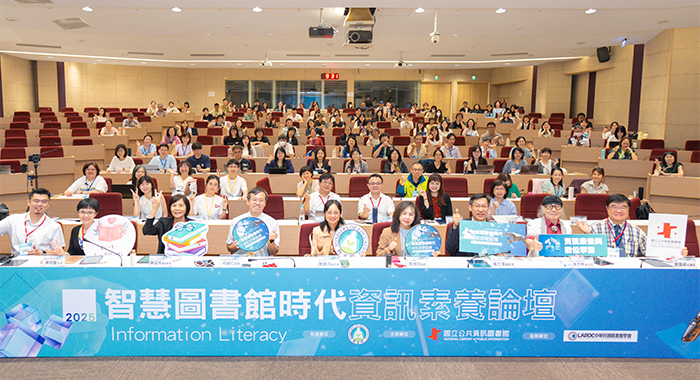
As the nation's first national level public library operating on both digital and physical tracks, the National Library of Public Information has actively developed a wide range of smart services. In mid-May 2025, NLPI hosted an Information Literacy Forum, bringing together experts and scholars from government, industry, and academia to explore the needs and challenges of information literacy in the context of digitalization and intelligent development. The event also marked a key step in building a comprehensive information literacy platform for readers across Taiwan.

As AI technology surges like an unrelenting tide, wave after wave reshaping every facet of life—from everyday routines to cutting edge innovations—industries across the board are harnessing artificial intelligence to forge entirely new landscapes. Libraries are no exception to this transformative wave.
While the library community in Taiwan continues to actively discuss the applications of smart services, the National Library of Public Information (NLPI)) had already begun laying the groundwork for intelligent transformation as early as 2012. Starting with book return sorters and book delivery robots, NLPI gradually expanded its suite of smart services. These include the Smart Book Pickup Zone, the iLib Guider APP for book navigation and mobile borrowing, the unified access card for digital resources, and the iSpace smart learning areas.
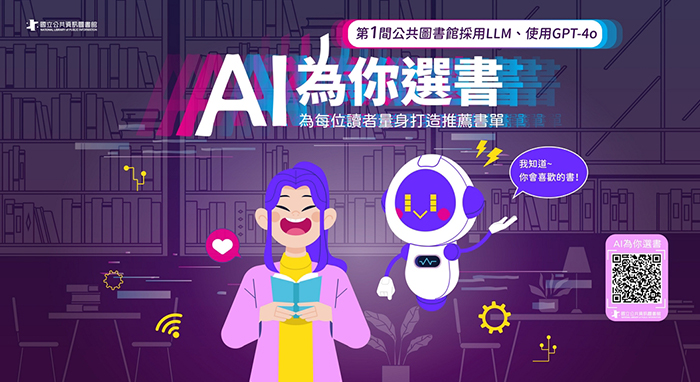
In late 2023, NLPI partnered with Tunghai University to launch "Xiao Shu," Taiwan’s first AI powered virtual librarian developed using generative AI technology. The following summer, the library officially introduced its “AI Book Recommendation” service, which leverages advanced analytical capabilities to provide readers with personalized reading lists tailored to their interests.
As NLPI's smart services have gradually matured and become more comprehensive, the library is now generously sharing the wealth of experience it has accumulated over the years. In 2025, it hosted the "Forum on Information Literacy in the Era of Smart Libraries", bringing together experts from various sectors to discuss strategies for enhancing information literacy and exploring practical solutions in the digital age. Through this initiative, NLPI aims not only to elevate the public’s digital literacy but also to inject fresh momentum for digital innovation into the library community.

Guided by Experts Opening New Horizons in Information Literacy
"Much of the information, data, and even knowledge we rely on in daily life now comes from online sources, which brings about issues such as misinformation, algorithmic bias, and indiscriminate content extraction," says Ma Xiang Ping, Director of the NLPI. In her view, amid the rapid growth of digital information, NLPI—as both a hub for knowledge dissemination and a pioneer in smart services—has a responsibility to stay attuned to the pulse of the times. It must help the public navigate key issues such as information literacy, digital ethics, and the effective use of digital resources. This is part of NLPI’s role as a national level digital public library.
With the rapid advancement of AI, modern information literacy goes beyond the technical level. It increasingly emphasizes how individuals can correctly interpret, critically evaluate, and maintain autonomy in learning within an ever-changing information landscape. The recent forum organized by NLPI represents a major step forward in promoting information literacy education. Bringing together professionals from the library sector, academia, industry, and schools, the event featured in depth discussions on a range of topics including "Information Literacy and Digital Learning," "Cybersecurity and Information Privacy," and "Digital Media Literacy and Content Creation."
The forum also showcased innovative services and transformation efforts of smart libraries. Through interdisciplinary dialogue, NLPI hopes to provide the library community with fresh perspectives and to shape a forward-looking blueprint for development—laying a solid foundation for reading in the age of intelligence.
Learning from the World: The Smart Transformation of Libraries
At the forum, NLPI Deputy Director Lai Chung Chin delivered a keynote titled “From Digital Libraries to Smart Libraries: The Challenges Ahead.” His presentation explored the current landscape of AI applications in libraries worldwide, the ongoing smart library initiatives at NLPI, and the potential challenges that future smart libraries may face.
Looking at international examples, the National Library of Sweden’s KB-Lab Data Lab developed a Swedish language natural language processing (NLP) model in response to the dominance of English in global AI training datasets. This localized model provides readers with a native Swedish knowledge database. In Singapore, the Central Public Library utilizes generative AI to encourage user creativity by allowing them to personalize classic stories. Through an interactive interface, users input prompts or images, guiding the AI to generate new storylines and matching illustrations. Meanwhile, Yokohama City Library in Japan has implemented an “AI Book Discovery” service powered by natural language search, enabling users to interact with the library catalog through conversational queries.
Lai Chung Chin affirmed that libraries around the world are creatively leveraging AI to broaden the horizons of smart services. In Taiwan, as the nation’s first national level digital public library, NLPI is actively keeping pace with AI developments, integrating smart technologies closely with traditional library functions to create a more intelligent and responsive service environment.

Generative AI Upgrading Smart Library Services
“With the advent of generative AI, NLPI’s smart applications have gained new dimensions in both imagination and execution,” remarked Lai Chung Chin. He cited the 2024 launch of the “AI Book Recommendation” service as a prime example. This service stands out for its deep analytical capabilities, enabling it to accurately grasp a reader’s preferences based on borrowing history or descriptions of reading interests, and to generate personalized reading lists accordingly.
Reflecting on NLPI’s journey in implementing smart services—starting earlier than many other libraries. Lai Chung Chin also acknowledged the limitations faced prior to the rise of generative AI. “Before generative AI, predictive AI often fell short,” he admitted. “If a reader’s query lacked precision or clarity, the typical response from predictive AI was simply: ‘Sorry, I couldn’t find the information you’re looking for.’”
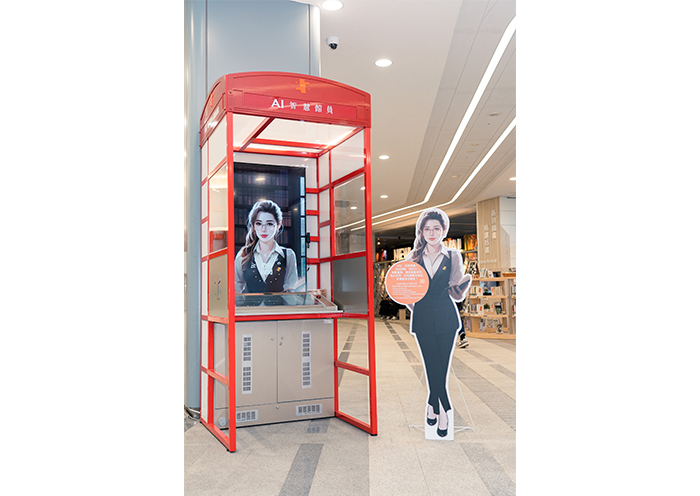
As AI continues to weave its way into daily life, NLPI in collaboration with a team from Tunghai University, successfully developed “Xiao Shu”—the first generative AI powered virtual librarian in Taiwan’s library sector. This breakthrough marks a significant departure from the limitations of earlier predictive voice response systems. With “Xiao Shu”, users can engage in natural, conversational interactions to obtain information such as library collections, service details, or even casual chats. The AI responds with human like dialogue tailored to the user's specific inquiries.
However, the journey toward a smart library is not without challenges. One of the foremost issues is content authorization. Lai Chung Chin explained that most library resources are protected by copyright, and their use in training language models typically falls outside the scope of original usage licenses. As a result, NLPI must seek permission from rights holders one by one to ensure proper legal use for AI training.
“Another challenge lies in the significant financial investment required for smart transformation,” Lai Chung Chin added. “With AI evolving at such a rapid pace, there’s always the risk that by the time development is complete, the technology may already be outdated.”
He further emphasized that embracing AI is not only about adopting faster tools, but also about upskilling people. “All library staff must acquire relevant competencies and become adept at using smart tools. Only then can they effectively assist the public in accessing and navigating information to meet their needs.”
Guardians of Digital Security: Safeguarding Library and Information Services
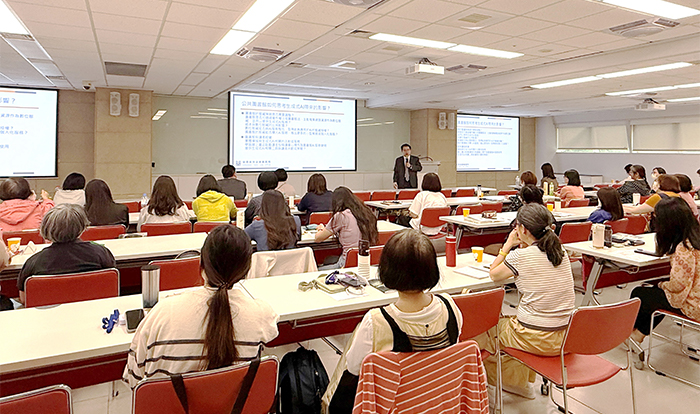
As smart libraries become an increasingly prominent trend, concerns over digital security are rising in tandem. At the forum, Hu Xin Yuan, Manager of the Research and Outreach Division at the Talent Development Center of the National Institute of Cyber Security, issued a timely warning: cyber threats are no longer a distant risk; they are already unfolding in libraries around the world.
For instance, on the evening of October 11, 2024, all 22 branches of the Calgary Public Library in Canada were forced to shut down due to a cyberattack. Although the libraries reopened on October 16, they were only able to operate in a limited, analog mode. Similarly, the Seattle Public Library (SPL) in the U.S. fell victim to a ransomware attack, prompting substantial investments in system recovery, cybersecurity consulting, legal advice, forensic investigation, and network reconstruction. In late February 2025, the Houston Public Library also suffered a cyberattack, which left residents unable to access its catalog or online resources. Even a month later, recovery efforts were still underway.
Hu Xin Yuan emphasized that the cybersecurity battle begins the moment libraries start building digital infrastructure. She pointed out that library information security is far more complex than it might appear. It involves sensitive elements such as unpublished source code, pre-publication manuscripts, readers’ personal data, email login credentials, internal meeting records, and access permissions to various databases. If compromised, these systems can lead to serious consequences: data breaches, service disruptions, or even the injection of false information into trusted platforms.

“Even if the attacker is not necessarily a hacker or acting with malicious intent, they can still cause a system crash,” said Hu Xin Yuan. She emphasized that when implementing smart services, security architecture must be built from the very beginning. By applying principles of secure design, libraries can significantly reduce cybersecurity risks. “It’s not just about early-stage prevention,” she added, “ongoing updates and patching vulnerabilities are equally crucial.”
Hu Xin Yuan also reminded participants that no security system is entirely foolproof. “Libraries must adopt a proactive approach. In the unfortunate event of a cybersecurity incident, are there recovery mechanisms or backup systems in place to ensure library operations can be swiftly restored?”
In an age driven by technology, ensuring information security has become a pressing concern across all sectors, and libraries are no exception.
The Birth of Xiao Shu A Human Centered AI Revolution in Libraries
Even though transforming into a smart library is not easy task—and comes with its own set of challenges and risks—the NLPI has remained steadfast in its commitment to innovation and service development. For Ma Xiang Ping, the driving force behind this transformation is not merely convenience or efficiency. At the heart of it all, she sees one essential element: people.
Ma Xiang Ping believes that the modern library is no longer just a repository of books. It is a space that provides vast amounts of information and resources. “The true focus of libraries should be on people,” she emphasized. “When someone walks into a library, starts reading, and uses information to enrich their life—that’s when a library truly fulfills its purpose.”
Thus, as AI technology continued to evolve, especially following the emergence of ChatGPT, which marked a turning point from traditional predictive AI to generative AI—Ma Xiang Ping made a decisive move. Without much hesitation, she chose to partner with academia to develop “Xiao Shu,” a smart virtual librarian. Her vision for “Xiao Shu” went far beyond a simple chatbot: she hoped it would be capable not only of articulating summaries of over a million books in the library’s collection, but also of instantly updating users on NLPI’s monthly events and responding to a wide array of user questions with thoughtful, personalized answers.
Ma Xiang Ping candidly described this as the greatest challenge since NLPI’s digital transformation began in 2013. “The core mission of a digital library,” she explained, “is to provide a space where digital technologies and physical services coexist—enhancing convenience and improving the user experience. But building digital infrastructure is costly, and AI is even more expensive.”
Throughout the development of Xiao Shu, the team faced not only financial constraints, but also technical roadblocks. Ma Xiang Ping had to continually guide and motivate the team to overcome obstacles at every stage. In the end, these persistent efforts paid off—leading to the successful creation of NLPI’s generative AI librarian, Xiao Shu.
Understanding and Harnessing AI Pioneers of Information Literacy in the Digital Age
With the launch of the virtual librarian Xiao Shu and the rollout of the “AI Book Recommendation” service, the NLPI has entered a new chapter in smart library services. Yet as AI becomes more deeply integrated into library operations, a host of new challenges have emerged—ranging from verifying information authenticity and ensuring digital security, to navigating intellectual property rights. These issues underscore the growing and urgent importance of information literacy in the AI era.
As a national level institution, NLPI not only oversees and supports public libraries across Taiwan but also serves as a vital ally to educators promoting reading in schools. Over the past two years, NLPI has undertaken a systematic training initiative, introducing frontline professionals to the latest technological trends and the evolving concepts of information literacy. The goal is to empower teachers and librarians to bring accurate, up to date knowledge into classrooms and library programs.
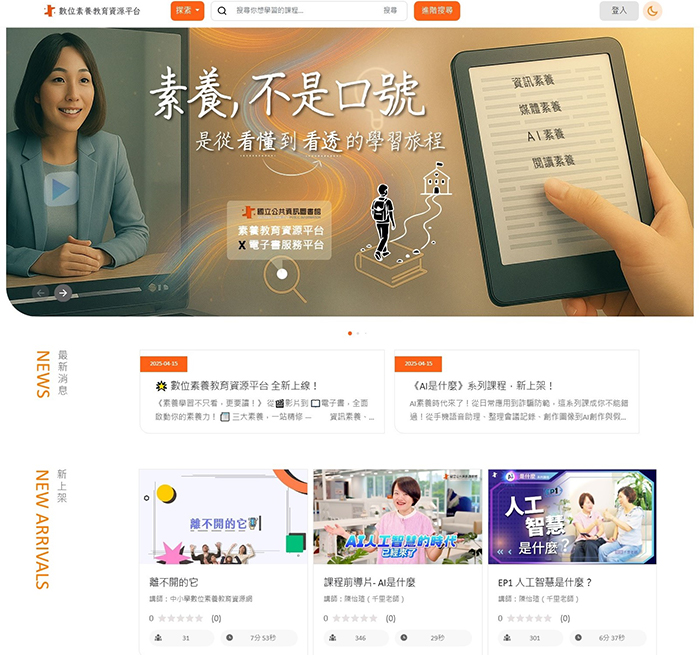
“This is the mission and meaning entrusted to NLPI, Ma Xiang Ping affirmed. Remaining at the forefront of innovation—and sharing those advancements with libraries and educational institutions across the country—has always been central to NLPI’s vision. Beyond organizing forums to harness collective expertise, the library also spent over a year mapping both official and unofficial courses and platforms related to information, digital, and media literacy in Taiwan. After extensive research and in person visits, NLPI launched the “Digital Literacy Education Resource Platform” in May 2025. This platform offers themed videos and e-books designed to help users gradually build their comprehension and critical thinking skills in a structured and accessible way.
“AI may sound futuristic, but in today’s world, it’s already a visible part of our everyday lives,” Ma Xiang Ping remarked. She firmly believes that, through expert guidance, the public can gain a clearer understanding of smart technologies and, in turn, strengthen their information literacy. “When we understand AI well enough, we can use its strengths wisely thinking, living, and even innovating with greater insight. That’s exactly the kind of transformation AI has brought to libraries—and can bring to our lives as well.”