




At its core, reading has always been a delightful encounter between the mind and knowledge. A library is not merely a space for housing books, but a cradle that nurtures curiosity and imagination. Amidst the digital wave, technology is no longer a cold wall of data, but a warm light guiding people into the depths of knowledge. When technology and the humanities gently intertwine, the library transcends time and space, accompanying readers through the glow of smart innovation to discover ever-expanding landscapes of reading.
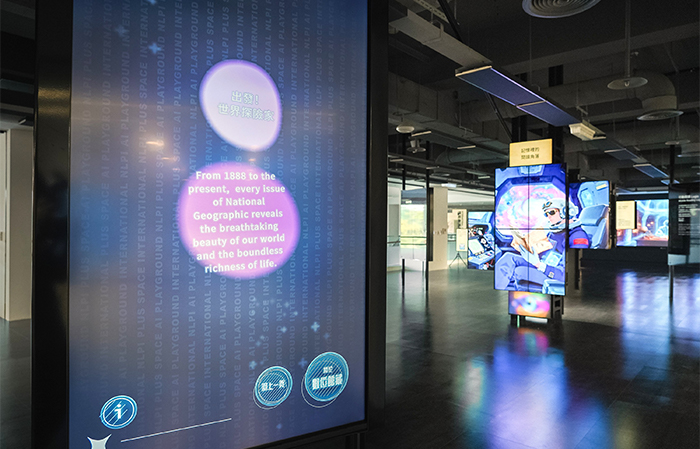
In the public imagination, libraries are often viewed as quiet, solemn spaces for storing books, accompanied by widespread anxieties about digital evolution—fears that "AI will replace books," "digital reading accelerates knowledge fragmentation," or "the library's role will be hollowed out." Libraries in the smart era are far more dynamic than we might imagine! By redefining the essence of "smart services," reading is no longer confined to physical pages and specific spaces; instead, it becomes a comprehensive sensory experience and a dynamic reconstruction of knowledge. This transformation is not a cold, mechanical replacement, but a magnificent evolution centered on spatial reinvention, emotional resonance, and collaborative creativity.
Spatial Evolution - From a Treasure Trove of Knowledge to Smart Co-Creation
As a technical expert in the field of AI, Zhou Zong Xin, Professor in the Department of Computer Science at Tunghai University and founding director of the Master's Program in Digital Innovation, observes that the evolution of libraries has followed a dynamic trajectory of continual transformation: from their original role as book repositories, to lending and reading centers that made knowledge accessible to the public, and, with the arrival of the digital age, into public spaces that connect people with the world. Yet the rise of generative AI is now triggering an entirely new wave of change.
“When AI can instantly answer encyclopedic questions, libraries must rethink what makes their physical spaces irreplaceable,” Zhou Zong Xin argues. In his view, libraries of the future will transform into “co-creation spaces,” offering hands-on creative experiences that cannot easily be replicated in the home environment. For example, readers may collaborate with AI in real time on a large library screen to design an airplane model or work together on a digital canvas to create artwork that transcends the boundaries between the virtual and the physical. This kind of “physical co-creation” service will move libraries beyond being mere places for reading and into intelligent spaces for creative incubation, enabling readers to rebuild deep sensory connections with the library and marking a profound transformation in response to technological challenges.

Xiao Shu, the Smart Librarian - A Bridge Between Knowledge and Emotion
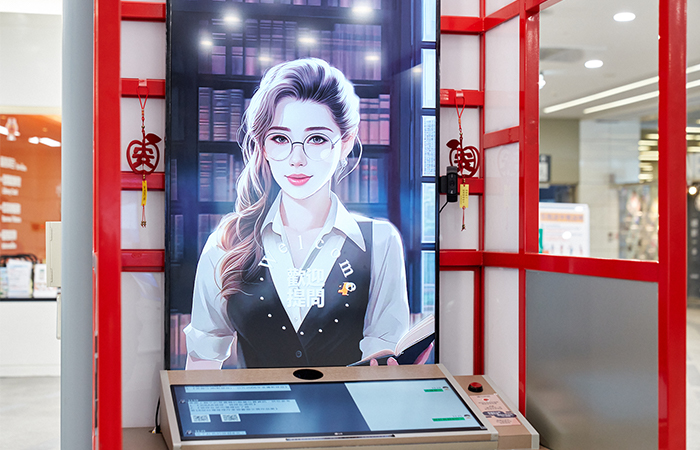
Among the most representative examples of transformation at the National Library of Public Information (NLPI) is the creation of its smart librarian, “Xiao Shu.” Looking back to the early wave of generative AI in 2023, NLPI Director Ma Xiang Ping had already begun in-depth discussions with Zhou Zong Xin. Although the library had already introduced robotic services at the time, their understanding of natural language remained limited, allowing only mechanical responses. Seeing new possibilities in generative AI technology, NLPI partnered with Professor Chou’s research team and incorporated the concept of a Digital Twin to develop “Xiao Shu,” Taiwan’s first smart librarian of its kind.
The challenge of this technological revolution lies not in data training, but in shaping the user experience. To eliminate the “hallucinations” commonly associated with AI and ensure the accuracy of information, the system automatically converts readers’ questions into code so that it can retrieve information precisely from the database, rather than allowing the model to generate responses entirely on its own. Interestingly, data shows that two-thirds of readers’ interactions with Xiao Shu consist of casual conversation, with some even developing a sense of emotional attachment. This demonstrates that when AI is given a distinctive persona and responds with empathy, it can effectively lower readers’ sense of distance from the library and build a more everyday, human-centered connection.
Human-AI Collaboration - Unlocking Librarians’ Expertise and Precision Services
In response to concerns that AI may replace human labor, Zhou Zong Xin takes a positive view grounded in the concept of “Human in the Loop.” He emphasizes that the role of AI is not to replace people, but to empower them: by allowing smart librarians to handle repetitive library inquiries, AI can significantly reduce the administrative burden on frontline librarians, enabling them to devote more time to higher-value research and strategic development, and allowing professional expertise to be fully applied where it matters most.
In addition, the development of smart librarians placed particular emphasis on distinguishing between different levels of service. For example, factual questions such as reading room regulations require accuracy in terms of whether the answer is correct, whereas book recommendations or lifestyle advice involve value-based judgments about whether the suggestion is appropriate or helpful. To address this, the development team engaged in repeated fine-tuning, gradually shaping Xiao Shu into a professional, approachable, and composed presence. This careful attention to detail reflects the humanistic commitment that remains indispensable in the smart era. When AI becomes a capable digital assistant, libraries can deliver services that are not only more efficient but also more personalized and precise, ensuring that every reader receives dedicated support tailored to their needs.
Digital Transformation - Reconstructing Logic Amid the Tide of Fragmentation
Lin Yu Jie, Chairperson of the Taiwan Cultural and Creative Industries Alliance Association and a long-time observer of developments in the cultural and creative sectors, has keenly identified the structural transformation of reading behavior. She points out that, with the rapid rise of AI-assisted audiobooks and summary apps, readers are increasingly accustomed to grasping the core ideas of a book during short commuting periods. This is not merely a technological revolution, but also a shift toward the fragmentation and efficiency-driven nature of reading habits. Yet she also offers a perspective that turns the issue on its head: although AI has intensified the fragmentation of reading, it has also unexpectedly become a form of salvation for this era.
“The fragmentation of knowledge brought about by the internet age once raised concerns about fractured thinking; yet AI’s powerful ability to organize logic can now piece those fragments back together, becoming a mirror that reflects and clarifies our reasoning,” Lin Yu Jie observes. She believes that in this age of information overload, AI can help readers build clear cognitive maps, prompting libraries to shift from being passive “keepers of knowledge” to becoming active “guides to knowledge.” Although AI is not one hundred percent accurate, she argues that the focus of human learning in the future will turn toward judging the purpose behind information. Readers may enter the library not always to seek a standard answer, but to find, within the frameworks organized by AI, the seeds of inspiration that spark the imagination.
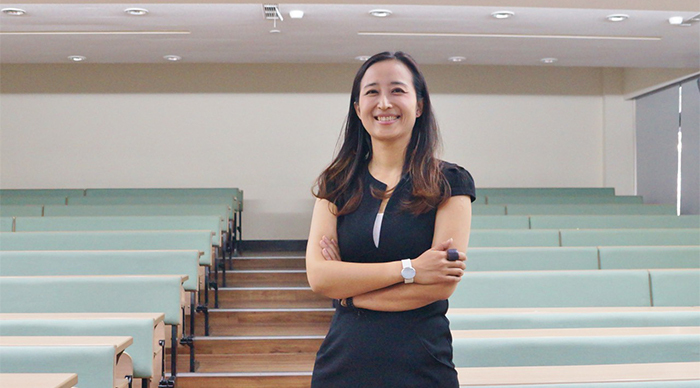
Shared Resonance of Inspiration - The Artistic Core Beyond Cold Code
Although generative AI is already capable of producing fluent text and analyzing sophisticated techniques, Lin Yu Jie emphasizes that the spark of humanity and shared emotional resonance remain irreplaceable. Taking Vincent van Gogh’s works as an example, she notes that the inner one feels when standing before a painting is a kind of soulful resonance that AI cannot simulate through training data. While AI can offer rational suggestions, its responses are fundamentally based on logic rather than genuine encounters between living souls.
Therefore, she believes that the libraries of the future should actively embrace “tech art” and seek to transform traditional texts into immersive, multisensory experiences. Through digital technology, readers will no longer engage with stories through sight alone but will also be able to touch the world of the narrative through multiple senses and interactive design. Lin Yu Jie argues that this shift in medium is key to drawing the “screen-symbiotic generation” into physical spaces. “No matter how easy access to knowledge becomes, the emotional connection formed between people and works, and between people and spaces, remains the cornerstone of human civilization. What libraries safeguard is not only history, but also that human capacity for perceiving beauty and civilization—the very quality that keeps us from becoming machines.”
A Kaleidoscope of Time - Rediscovering the Social Warmth of Physical Spaces
In a highly digitalized future, the social value of libraries will not diminish; rather, it will continue to grow. Lin Yu Jie shares with a smile that the importance of spaces such as the newspaper reading area in a library lies not only in the newspapers themselves, but also in the way such spaces offer older adults a new place for social connection. In the simple moments of turning a page, standing up, or exchanging a glance or greeting with others, these physical spaces create a sense of belonging and warmth that digital life can hardly replace, providing essential emotional nourishment.
To Lin Yu Jie, the library of the future is like a “kaleidoscope” filled with ever-changing possibilities. Within this space, readers can connect with the distant histories of human civilization while also using technology to spark boundless imagination about the future. It is both a sanctuary of wisdom that preserves human knowledge and a warmly human station of emotional connection, continually creating new cultural expressions in the flow of time.
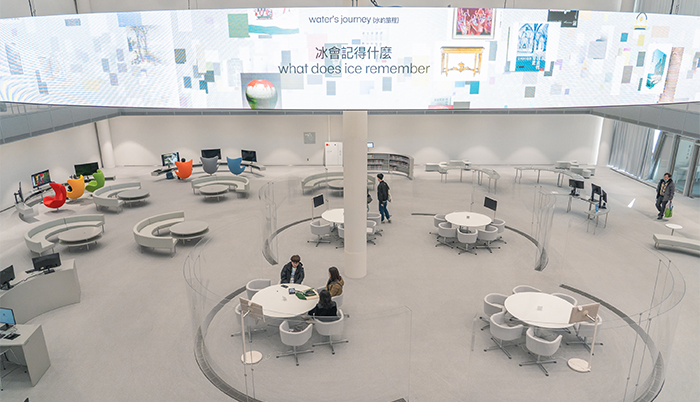
AI illuminates the future, giving knowledge a broader and more expansive form, while libraries, through transformation, integrate space, emotion, and creativity to reveal a new vision for the smart era. In doing so, they continue to light the way for every journey into the unknown, allowing the beauty of reading to flourish enduringly in the digital age.