




In an era of rapid advances in medical technology, the role of laboratory animals is quietly changing. From mice to chips, the National Center for Biomodels(NCB)leads readers through the front lines of disease validation through this exhibition, showing how science is redefining the meaning of a “surrogate” while balancing ethics and precision.
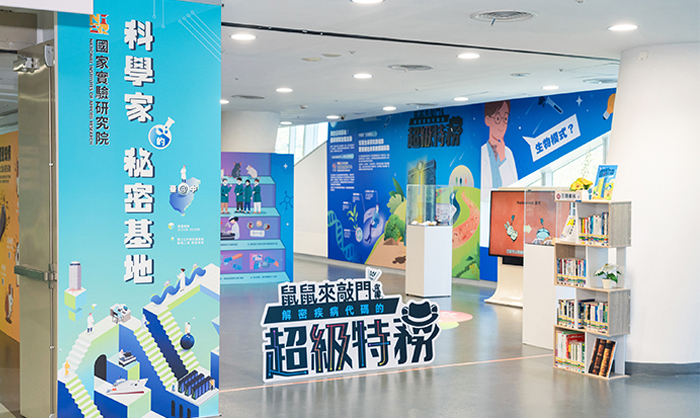
As visitors step into the exhibition area on the second floor of the National Library of Public Information, the first thing they encounter is a familiar little creature, newly cast in an unexpected role: the mouse. Serving as the starting point of this exhibition, it leads visitors into a story about disease research, medical safety, and technological transformation.
The exhibition, "A Knock at the Door from Our Little Mouse Friends: Super Agents Decoding the Disease Code", is organized by the National Center for Biomodels(NCB), formerly known as the National Laboratory Animal Center(NLAC), which has now officially adopted its new name. Through wall texts, visual displays, videos, models in display cases, and interactive installations, visitors can gain insight into the center’s recent shift in research focus and its evolving role within today’s healthcare system.
From the National Laboratory Animal Center to the National Center for Biomodels
More than 30 years ago, the center was established with a clear mission: to build a stable and reliable supply of laboratory animal resources and to safeguard the development of new drugs and medical technologies. For a long time, animals served as humanity’s most important stand-ins.
However, with advances in biomedical technology and data science, validation is no longer a one-way path. Artificial intelligence can now be used to screen high-risk compounds in advance, while cells and micro physiological systems are able to simulate certain organ functions outside the body. Combined with traditional animal models, these approaches guide biomedical research toward greater precision and closer approximation to human biology.
According to Chin Hsien Ching, Director of the NCB, the center’s core mission has shifted from “providing animals” to “building models.” Its goal is to establish a diverse and reliable validation system that can better safeguard human safety and the effectiveness of medical care.
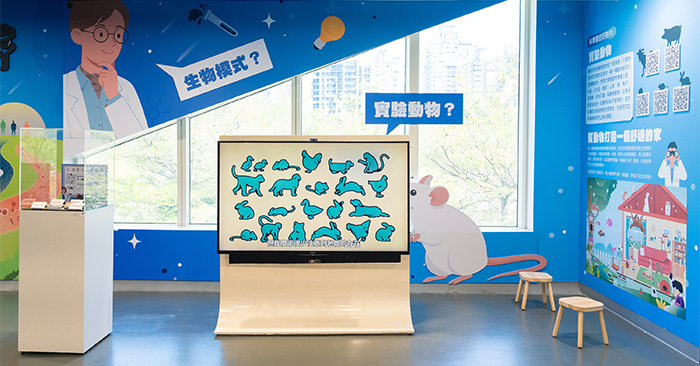
Understanding the Practice of Research Ethics through the 4R Principles
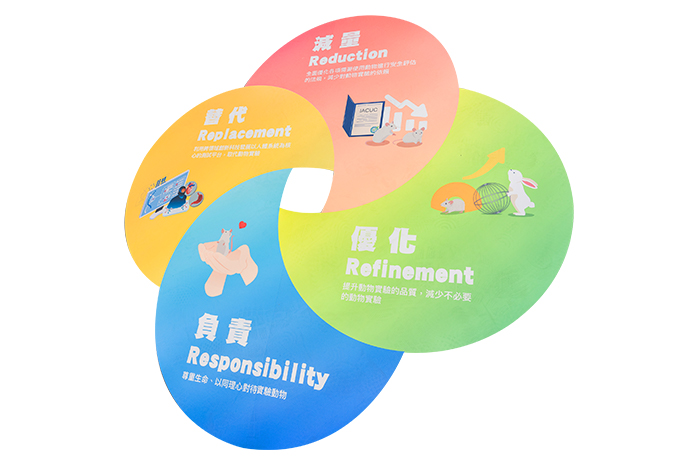
Seen in this broader context of transformation, the 4R Principles emerge as a key concept repeated throughout the exhibition. The “4Rs” refer to Replacement, Reduction, Refinement, and Responsibility, which together represent the core values of contemporary laboratory animal science and biomodel research. Through the different exhibition sections, visitors can gain a deeper understanding of how these principles are put into practice.
The exhibition seeks to bridge the boundary between tradition and the future. Beginning with the diversity of laboratory animal species and the enrichment of their living environments, it reflects a fundamental concern for life. It then uses a step-like visual structure to guide visitors through the process of experimental design, prompting reflection on how to strike a balance between non-animal training methods and advanced technologies to reduce unnecessary sacrifice.
Finally, visitors are brought to the forefront of biomodel innovation, where they can witness the latest applications of organ-on-a-chip technology. Together, these displays convey a clear message: the future of animal experimentation lies in using animals with greater precision. At the same time, within a framework where multiple models work side by side, animal experimentation is no longer the only option, but rather an important part of a collaborative system that also includes chips, cells, and AI-driven data.
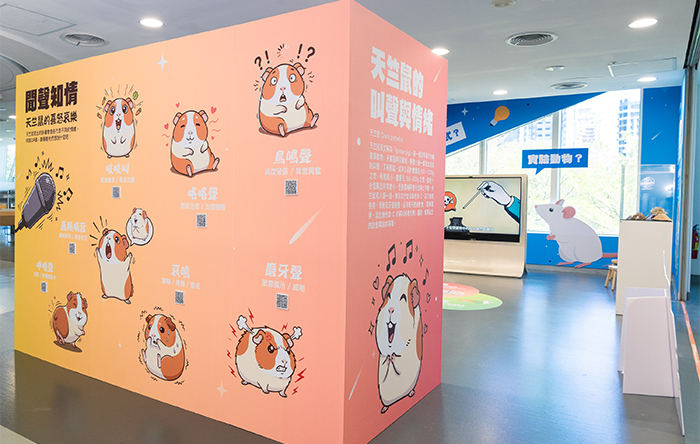
In addition, there is an interactive section that is especially popular with children. Visitors can listen to different guinea pig vocalizations on site and learn how researchers use technology to interpret animals’ emotions and physical conditions. This design is not intended simply for entertainment. “When we are able to detect signs of discomfort in animals at an earlier stage, we can promptly adjust their care and experimental conditions, making research both more humane and more reliable,” said Chin Hsien-Ching, Director of the NCB.
Diverse Research Models - Redefining the Future of Medical Validation
Organ-on-a-chip technology is another major focus of the exhibition. Through physical models and animated displays, these miniature systems—once confined to the laboratory—are translated into a visual language that the public can readily understand. Chin Hsien-Ching offers an apt metaphor: “An organ-on-a-chip is like taking a slice from a whole, preserving its structure and interactions without attempting to recreate the entire organism.”
Looking back at the little “mouse” introduced at the beginning of the exhibition, visitors may realize that what it represents has quietly changed. It is no longer merely an object of study, but a member of a broader biomodel system, working alongside chips, cells, and AI to help researchers understand how diseases develop and to improve the success rate of drug development.
Through its spatial arrangement, visitor flow, and interactive design, the exhibition helps the public understand how contemporary science moves forward by balancing ethics with precision. When there is no longer only one kind of stand-in, and when methods of validation continue to evolve, the future of medicine is also being redefined.
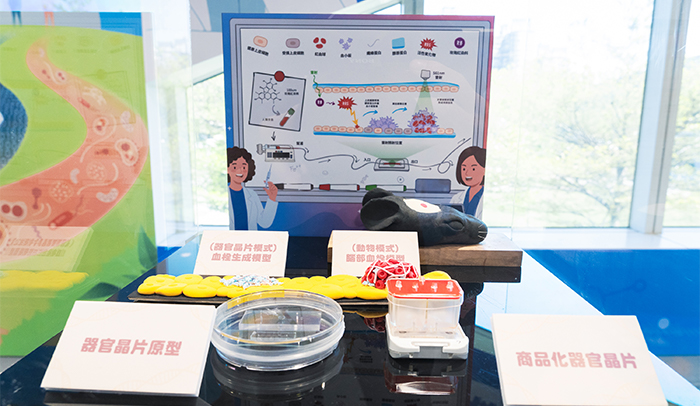
A Knock at the Door from Our Little Mouse Friends: Super Agents Decoding the Disease Code