




5,000 years ago, the Earth was shrouded in the deep freeze of the last glacial period, and the ancestors of humankind (including Neanderthals) hid in caves or rock shelters to keep warm. Trudging out to look for food, they would quickly return to the caves, because it was simply too cold outside. Spending days and nights huddling in these caverns, with only limited space to move around despite the many chambers within, they eventually began, out of boredom and frustration, to doodle on the surrounding rock walls.
They painted all kinds of animals: some robust, some slender, some ferocious, some gentle, with vivid and varied hair and skin that reflected the ecology of their living environment. These carefully executed paintings also marked a shift in human mentality, from mere calculation to deliberate strategizing. Even more interestingly, paleoanthropologists examining the skulls of our distant ancestors discovered that during this period, the cerebellum grew larger, while the cerebrum became asymmetrical, with the left hemisphere larger than the right, giving rise to the phenomenon of lateralization of cognitive functions. This evidence clearly shows that the advancement of the mind depends on the support of the brain.
In recent years, evidence of brain–mind interaction obtained using various brain-imaging tools has likewise shown that higher-order mental abilities require strong neural activity in the brain to sustain them. Consequently, scientists pay special attention to the level of brain energy in newborn infants. From an evolutionary perspective, infants are born with an innate capacity for learning and possess a perceptual ability akin to statistical computation for detecting changes in surrounding sounds, sights, and objects, which is called experience-independent learning. Naturally, there are individual differences in how sensitive newborns are to changes in their environment. The key question is whether these individual differences—ranging from high to low—will influence later, experience-dependent learning that can only be acquired through interaction with the world.
This question is important because scientific studies have confirmed a strong correlation between the strength of infants’ innate brain energy and their later performance in language acquisition. An even more crucial question, then, is what kinds of reinforcement methods parents can use, in the course of everyday interaction, to guide infants and young children in developing higher-order cognitive functions and boosting the energy of neural activity. In recent years, research on infant brain development has provided a very positive and encouraging answer to this question.
To measure brain activity in 6‑month‑old infants, it is difficult to use the magnetic resonance imaging (MRI) scanners typically employed with adults, because babies cannot possibly lie inside the machine and keep their heads still, and once they move, the resulting images are blurred. In addition, MRI systems are extremely expensive. Thanks to the development of advanced near‑infrared spectroscopy (NIRS), researchers can now attach measurement opt odes to an infant’s head while the baby is safely and quietly held in a parent’s arms, making it the most commonly used and most infant‑friendly brain‑imaging tool in current infant studies.
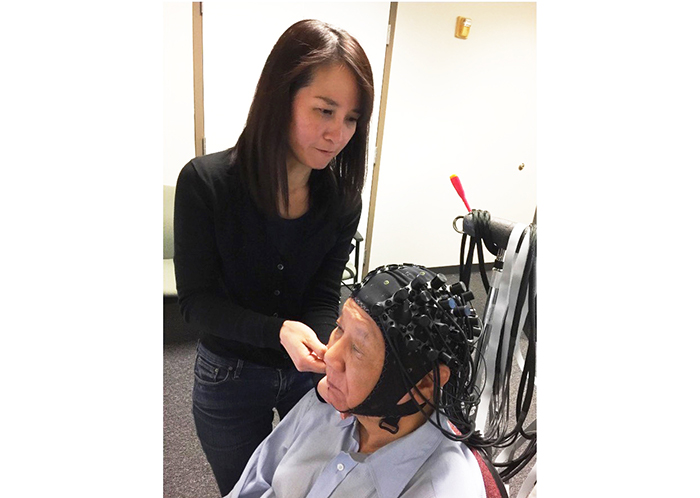
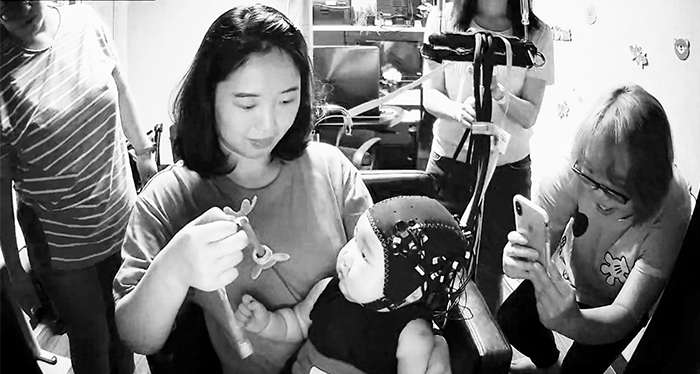
This series of experiments has been led by Professor Wang Xin‑Min of the Department of Human Development and Family Studies at National Taiwan Normal University, working with Richard Aslin, a member of the U.S. National Academy of Sciences and a professor at Yale School of Medicine, to investigate 6‑month‑old infants’ predictive abilities using NIRS. How is this done? Researchers manipulate sequences of stimulus for example, every time an auditory stimulus occurs, a visual image appears at the same time; after many such pairings of sound and image, the sound is presented but the visual image is sometimes omitted. At those moments, the visual cortex at the back of the infant’s head shows clear hemodynamic responses, indicating that the infant has noticed that the expected pattern has been violated.
The studies show that when a sound is presented but the expected picture does not appear, the occipital lobe, which supports the visual system, produces neural responses of varying strength, and the magnitude of this brain‑based prediction signal is significantly correlated with the infants’ spoken vocabulary when they reach 12 and 18 months of age. In other words, the stronger the neural prediction signal in the brain at 6 months, the better the child’s subsequent spoken language development. This is an important new finding, demonstrating that infants’ innate neural energy truly influences the quality of language they learn from the environment as they grow. Encouragingly, further research has found that for young children whose neural functioning appears less robust in infancy, the energy of neural processing can be strengthened through experience‑dependent learning in the form of parent–child shared reading, thereby promoting their language development.
Parent–child shared reading exerts a powerful positive effect on strengthening cognitive functions in the brain, which is especially meaningful for contemporary societies facing low birth rates. Research also shows that effective shared reading rests on appropriate interaction strategies: parents do more than simply open a book and read it aloud word for word. Instead, they keep asking questions that match the content, such as “What happens next?”, “Why?”, or “What might the outcome be?”, and they guide the child to recall the story with prompts like “What just happened?”. They also build on the child’s responses, expanding and extending them with richer explanations. A three‑year longitudinal study conducted in Yilan has shown that the richer the interactions during shared reading, the more opportunities children have to exercise and strengthen the brain’s predictive abilities, thereby enhancing their language skills. So, parents, pick up a book, hold your precious child close, and read together to power up the brain. (The author is an Academician of Academia Sinica.)